
Davao market updates
Davao Real Estate Market Overview (2026): What Every Informed Buyer Needs to Know

Table of Contents
Davao's property market has been quietly outpacing many Philippine cities. Here's an honest, area-by-area look at what's driving demand, which corridors are emerging, and what it means for buyers in 2026.
This guide is educational and maintained for Davao property buyers, sellers, and investors. For decisions specific to your situation, consult a licensed attorney, accountant, broker, or financing professional.
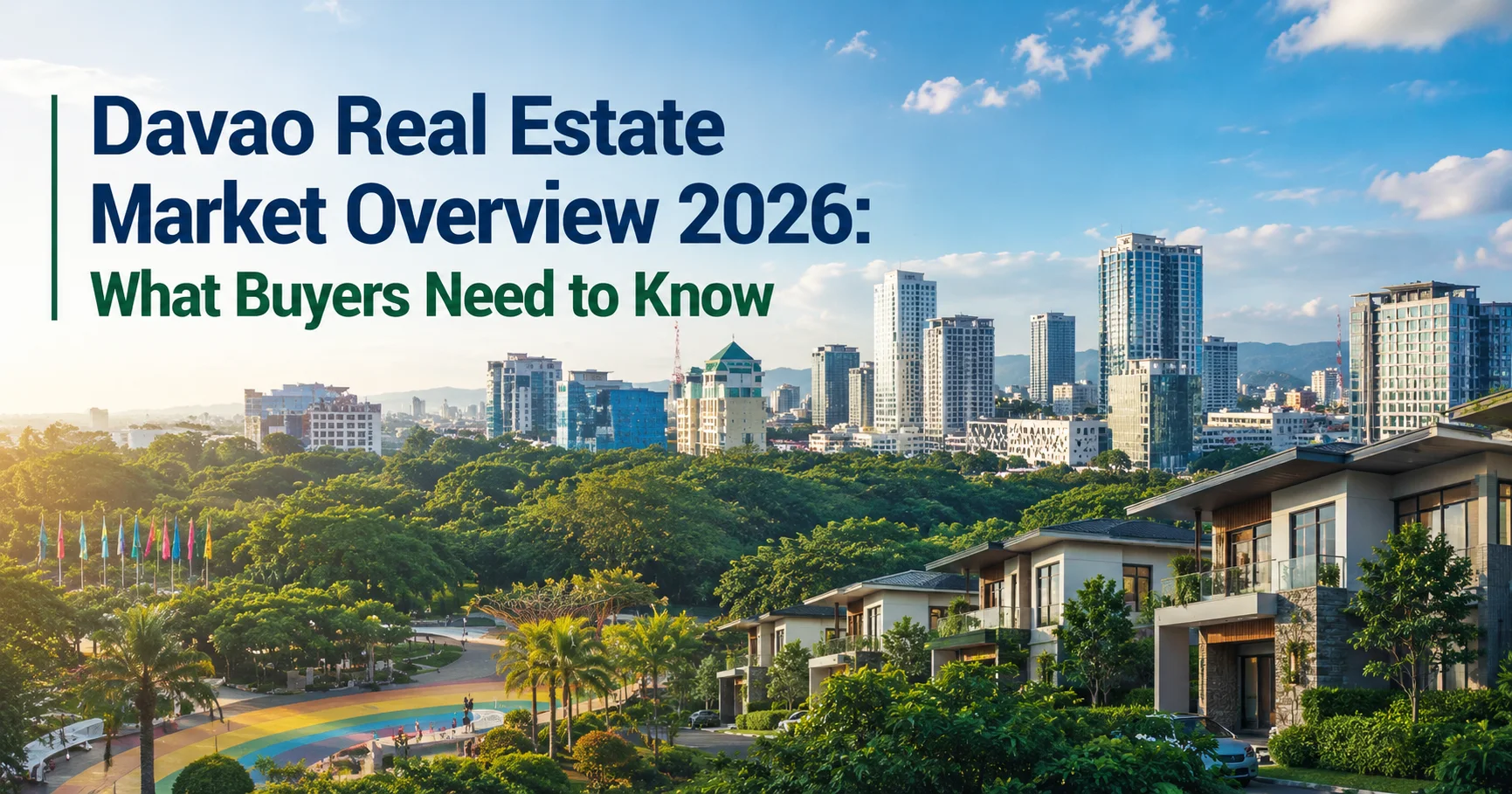
Why More Buyers Are Looking South
For a long time, the conversation about Philippine real estate began and ended in Metro Manila. That's changing. Over the past decade, a quieter story has been building in Mindanao — one that doesn't make as many headlines but shows up clearly in the numbers: more families relocating, more OFWs sending money south, more developers from Manila opening offices in Davao, and more mid-range buyers realizing that what ₱8 million buys in Quezon City doesn't come close to what it buys here. Davao City is the largest city in the Philippines by land area. It has consistently ranked among the country's safest and most livable cities. Its economy has diversified well beyond agriculture into logistics, BPO, retail, and services. And unlike Metro Manila, it still has room — physical, social, and financial — to grow. But this article isn't a sales pitch for Davao. It's an honest market overview for the kind of buyer who wants to understand what they're buying into before they buy. Because the Davao property market, like any market, rewards patient and informed buyers — not people chasing headlines or following speculation. Some areas are genuinely excellent right now. Others are getting ahead of their fundamentals. Knowing the difference is exactly what this guide is for.
This market overview is maintained by the MM Properties editorial team and licensed practitioners with direct experience in Davao City and surrounding areas. We update this annually. All price ranges are indicative; verify current figures with active listings and registered brokers. This content is educational, not investment advice. Last reviewed: June 2026.
What's Actually Driving Davao's Property Demand
Before looking at specific areas, it helps to understand why demand in Davao has been on a sustained upward trajectory. There are five main drivers — and understanding them tells you more about the market than any single price figure. 1. Internal Migration From Mindanao's Provinces Davao City functions as Mindanao's economic capital. Families from General Santos, Cotabato, Tagum, Digos, and surrounding provinces relocate here for education, healthcare, and employment. This internal migration creates steady, organic housing demand that isn't tied to a single employer or economic cycle. This matters because it represents real end-user demand — people who need places to live, not speculative buyers waiting to flip. Markets driven by end-user demand tend to be more stable over time. 2. OFW Remittances and Retirement Investment Davao has a large and growing OFW community. Many overseas workers from Mindanao have parents, siblings, or spouses living in the city — and purchasing property here is both a financial investment and a form of family care. The ₱5M–₱15M segment in particular has seen consistent interest from OFWs who want something solid: a house in a good subdivision, or a lot in a developing area, bought while they're still earning abroad.
3. The Rise of Condo Development in the City Core Until relatively recently, Davao was predominantly a house-and-lot market. That has shifted meaningfully. The past several years have seen a notable rise in condominium projects — particularly in the Ecoland, Matina, and Bajada corridors — as developers from Manila recognized that Davao's growing professional class wanted urban-style living with amenities. This has created a new market segment that didn't meaningfully exist a decade ago: mid-range condominiums priced between ₱3M and ₱10M, targeting young professionals, remote workers, and investors seeking rental income near business districts. The growth is real — but so is the caution required. Condo supply in some pockets is rising faster than rental absorption. More on that in the area-by-area section below. 4. Davao Coastal Road and Reclamation Development The Davao Coastal Road project — a major infrastructure investment connecting the southern and northern parts of the city along the bay — is one of the most significant urban development events Davao has seen in years. Beyond its traffic-decongestion purpose, it is reshaping land values along the western coast of the city. Reclamation areas adjacent to the coastal road have attracted developer interest, with mixed-use projects announced for several parcels. These developments are in early to mid stages as of this writing — which means they represent both opportunity and risk, depending on timeline and developer credibility. What this means for buyers: Properties near the coastal road corridor — particularly in the Talomo and Toril coastal zones — are seeing increased developer and investor attention. Land values in some of these areas have moved. For end-user buyers, the practical benefits (better road access, future commercial hubs) are real but will take years to fully materialize.
5. Livability as a Long-Term Value Driver This one is harder to quantify but matters enormously: Davao is simply a pleasant city to live in. Consistently ranked among the Philippines' safest cities, it has less traffic than Manila and Cebu, lower cost of living, functional public services relative to its size, and a climate that, while tropical, avoids the typhoon belt that affects much of the country. Livability attracts and retains residents — and retained residents create sustained housing demand. It's not a flashy metric. But over 10–20 year holding periods, cities that people want to live in tend to see steadier property appreciation than cities people merely tolerate.
Area-by-Area Market Overview
Every area of Davao has a different profile of buyers, price points, demand drivers, and risk factors. Here's an honest look at each of the main corridors.
Poblacion / Downtown Davao
Davao area insight
Character
The historic commercial and civic center. Dense, active, urban. Home to government offices, the old business district, wet markets, and the port area.
Ecoland / Matina / Buhangin
Davao area insight
Character
Davao's most established mid-to-upper residential and commercial corridor. Home to major malls, private schools, hospitals, business process outsourcing offices, and the densest concentration of condominium development in the city.
Toril / Tugbok / Mintal
Davao area insight
Character
The city's southern residential growth corridor. Quieter, greener, and substantially more affordable than Ecoland/Matina. Historically associated with agricultural land; increasingly home to newer subdivisions catering to families priced out of the city center or seeking more space.
Catalunan Grande / Catalunan Pequeño
Davao area insight
Character
A transitional zone between the urban density of Matina and the suburban sprawl of Toril. Home to a mix of established and newer subdivisions, commercial strips along national roads, and some of Davao's most sought-after mid-range subdivision addresses.
Calinan / Baguio District
Davao area insight
Character
Davao's western growth edge. Largely rural and agricultural in character, with pockets of residential development along main roads. The Baguio District, centered on Calinan proper, is known for its cooler climate due to elevation.
Samal Island (IGACOS)
Davao area insight
Character
The Island Garden City of Samal, a separate local government unit connected to mainland Davao by a short ferry ride (and, eventually, a bridge). Known for beaches, resorts, and a growing residential community catering to Dabawenyos who want weekend or retirement retreats.
The Condo Market: A Closer Look
The rise of condominium development in Davao deserves its own section, because it's the part of the market that has changed most visibly in the past five years — and where the most nuance is required. What's Changed? A decade ago, Davao was overwhelmingly a house-and-lot market. Condominiums existed but were limited in number and largely targeted at a narrow professional segment. That has changed substantially. National developers — recognizing Davao's growing professional class, BPO sector, and OFW investment interest — have opened multiple mid-range condo projects, particularly in the Ecoland, Matina, Bajada, and Buhangin corridors. This is, broadly, a positive development. It has given buyers more options at more price points and brought amenity-rich urban living to a city where that previously didn't exist at scale. The Supply Question The honest caveat: condo supply in some parts of Davao has grown faster than rental absorption. Multiple projects completing around the same period means more units competing for the same pool of tenants. Rental yields that were strong a few years ago have compressed in certain building types and locations. This doesn't mean condo investment is wrong. It means the analysis needs to be more specific than "Davao is growing, therefore this condo will rent well." Questions every condo investor should answer before buying:
- What is the current occupancy rate in comparable buildings within 500 meters?
- Who is your tenant profile? Is it BPO workers, young professionals, students, expats?
- What is the average rental rate for a comparable unit today? And not at launch projections!
- What are the total monthly carrying costs (dues, taxes, loan amortization) and at what occupancy does the investment break even?
For end-user condo buyers or the people who plan to live in the unit, these questions matter less. The lifestyle value of a well-located, amenity-equipped condominium in Davao's core is real and doesn't depend on rental yield.
What the Market Doesn't Reward
Because MM Properties' philosophy is education first, this section is as important as anything above. The Davao market has genuine long-term fundamentals. But it does not reliably reward: Short-term flipping. Transaction costs in Philippine real estate (5–8% on entry, taxes on exit) mean you need meaningful appreciation just to break even on a short hold. Davao is not a flipping market. Buying based on infrastructure announcements alone. Announced projects in the Philippines frequently delay. Land prices often rise on the announcement and stay elevated whether or not the project delivers on time. Buy the property, not the press release. Overpaying for a pre-selling project based on projected appreciation. Pre-selling prices have risen significantly across Davao as developers price in future demand. The discount for buying early has narrowed. Model your numbers on today's comparable rents and values, not optimistic projections. Buying in an unfamiliar area because it's cheap. Emerging areas have real risk — of delayed infrastructure, of developer non-completion, of slower-than-projected population growth. The reward for that risk should be commensurate. If the upside isn't compelling relative to the uncertainty, a more established area at a slightly higher price is often the better risk-adjusted choice.
A Simple Framework for Evaluating Any Davao Property
Before we close, here's a practical filter you can apply to any property or area you're considering:
| Question | What to Look For |
|---|---|
| Is there existing end-user demand here? | People already living, working, studying nearby — not just projected future demand |
| Are the fundamentals established or promised? | Roads, schools, utilities, markets — present today, not in 3 years |
| Does the price reflect today's reality or tomorrow's hope? | Compare to actual recent sales in the area, not developer projections |
| Can I hold this for 7–10 years if needed? | Davao rewards patience. Don't buy if you can't hold. |
| Does it work at today's numbers without the upside? | If the investment only makes sense if the bridge gets built / the road improves / the BPO expands — it's a speculative bet, not an investment |
If you can answer yes to all five, you're looking at a genuinely well-positioned property. If you find yourself rationalizing on two or more, take that as a signal to look harder or look elsewhere.
Frequently asked questions
Is Davao real estate a good investment in 2026?+−
For patient, informed buyers focused on end-user demand corridors, Davao's fundamentals remain solid. The city's population growth, economic diversification, and infrastructure investment provide a reasonable long-term foundation. That said, not all areas or property types carry the same risk-reward profile. Do area-specific analysis, not city-level optimism.
Which area of Davao is best for buying property?+−
It depends on your purpose. For urban lifestyle and rental investment: Ecoland / Matina / Buhangin. For family house-and-lot at accessible price points: Catalunan Grande / Pequeño. For space and affordability: Toril / Tugbok / Mintal. For lifestyle and long-term land: Calinan / Samal. There is no single "best" and only best for your situation.
Are Davao condo prices rising?+−
Pre-selling prices have risen as developers price in anticipated demand. Completed-unit resale prices and rental rates have been more variable, with some compression in oversupplied pockets. Research specific buildings and comparable units. Don't rely on developer marketing projections.
How does Davao real estate compare to Manila or Cebu?+−
Davao offers significantly lower absolute price points than Metro Manila and competitive pricing relative to Cebu, with higher land availability and lower density. The trade-off is a smaller market with less liquidity — selling a property in Davao typically takes longer than in Metro Manila. For long-term holders, this trade-off is often acceptable. For buyers wanting a liquid, sellable-quickly asset, Manila or Cebu may be more suitable.
Is Samal Island a good property investment?+−
Samal offers genuine lifestyle value and consistent demand from Dabawenyos seeking vacation and retirement properties. The long-discussed Davao-Samal bridge would be transformative — but timelines are uncertain. Buy Samal for what it is today; treat the bridge as potential upside, not as the foundation of your investment case.
Conclusion: Informed Beats Early. Patient Beats Rushed.
Davao's property market in 2026 is not a secret. Developers know it. Investors from Manila and Cebu have noticed it. OFW buyers are active in it. But it is still a market where doing your homework pays. Where buying in the right corridor at the right price point, and holding with patience, has historically delivered better outcomes than chasing the newest project or the most-hyped emerging area. The buyers who've done well here, and we've worked with many of them, share a consistent profile: they understood what they were buying before they bought it. They knew the neighborhood, modeled their numbers honestly, and held without panic when the market moved slowly. That approach is available to anyone willing to invest the time in understanding the market first. This overview is the starting point. The next step is to go deeper on the specific areas, financing options, and buying process that are relevant to your situation.
Related reading

buying_guide
The Complete Guide to Buying Property in Davao, Philippines (2026)
Planning to buy property in Davao? This guide covers everything from financial readiness to title transfer—written for first-time buyers, OFWs, and investors who want to make confident decisions.
buying_guide
Why Davao City Real Estate Is a Smart Investment for Investors, OFWs, and First-Time Home Buyers
The demand for Davao City real estate continues to grow as more investors, Overseas Filipino Workers (OFWs), and working professionals recognize the value of owning property in one
buying_guide
Condo vs. House and Lot in Davao: Which Is Right for You?
Torn between a condo and a house and lot in Davao? This honest comparison covers total cost of ownership, lifestyle fit, and long-term value , with a clear decision framework at the end.
This article is for educational purposes only and does not constitute financial, legal, or investment advice. Market conditions, prices, and infrastructure timelines change. Verify current figures with active listings, registered brokers, and relevant government agencies before making any property decision. © 2026 MM Properties Davao. Last reviewed: June 2026.