
Buyer guides
The Complete Guide to Buying Property in Davao, Philippines (2026)

Table of Contents
Planning to buy property in Davao? This guide covers everything from financial readiness to title transfer—written for first-time buyers, OFWs, and investors who want to make confident decisions.
This guide is educational and maintained for Davao property buyers, sellers, and investors. For decisions specific to your situation, consult a licensed attorney, accountant, broker, or financing professional.
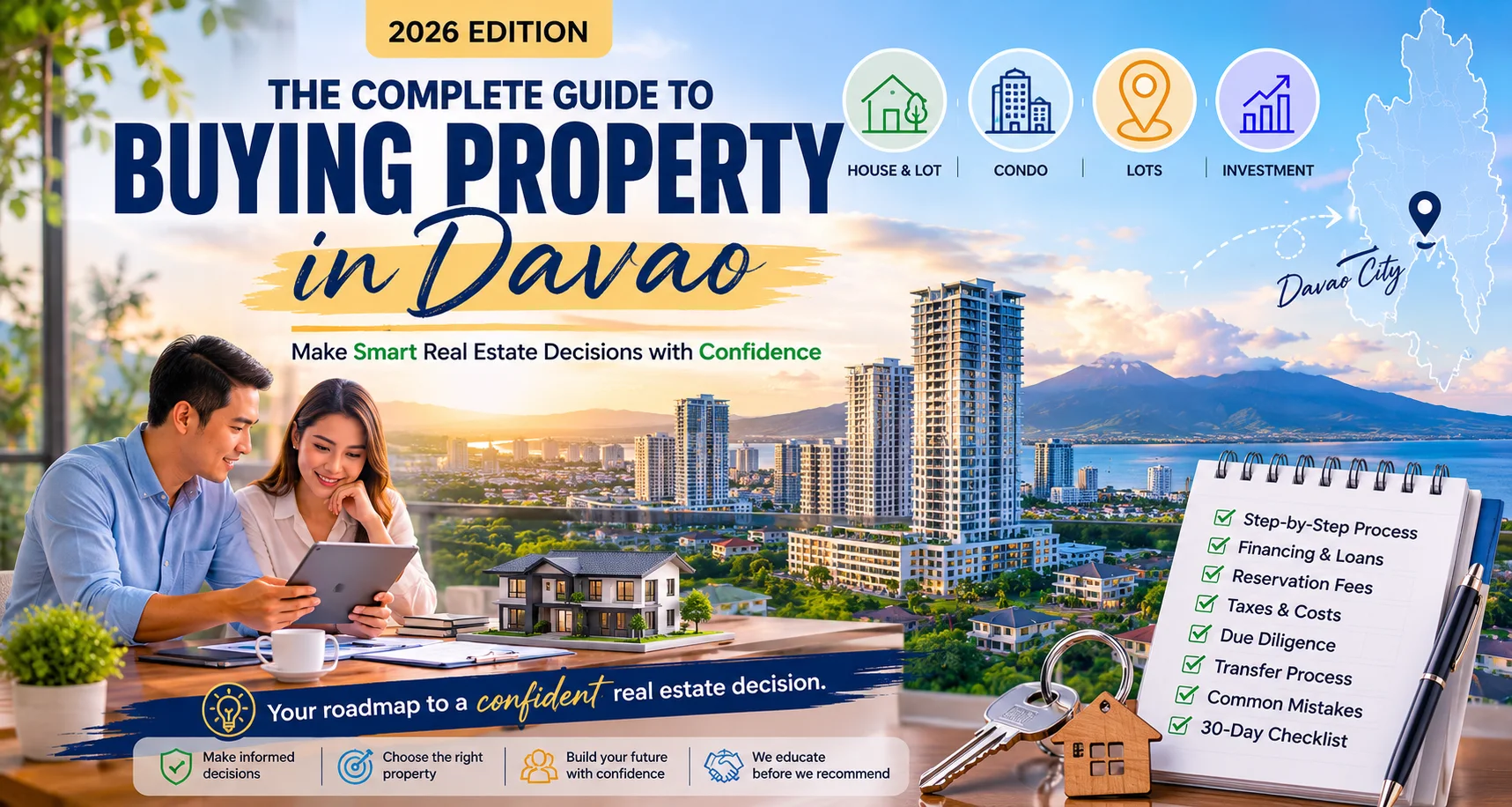
Buying property in Davao is likely the largest financial decision you will ever make. And if you're reading this, you probably already know that!
You Have More Questions Than Anyone Is Answering
Maybe you've been scrolling through listings for months, feeling equal parts excited and overwhelmed. Maybe you sat through a developer's sales presentation and walked away more confused than when you arrived. Maybe a friend bought a condo last year, and now you're wondering if you should do the same or if you're already too late. You're not alone. Most buyers in Davao, whether they're first-timers, OFWs saving for retirement, or families thinking about upgrading, carry the same quiet anxiety: What if I get this wrong? This guide exists to answer that feeling honestly. At MM Properties, we live by a simple idea: we educate before we recommend. We won't tell you to buy right now, or scare you into acting before you're ready, or bury you in jargon to sound impressive. Instead, we'll give you the clearest, most practical picture of buying property in Davao so that when you do make a decision, it's yours, made with full information and genuine confidence.
- Whether you're actually ready to buy right now
- How to choose between a house, condo, and residential lot
- The real total cost of ownership! Not just the monthly payment.
- How financing through banks, Pag-IBIG, and in-house works
- A due diligence checklist that protects you from title fraud
- Every tax and fee you'll pay when transferring property in Davao
- The 15 most common mistakes buyers make and how to avoid them
Let's start at the beginning.
Part 1: Are You Ready to Buy Property in Davao?
Before you look at a single listing, answer this more fundamental question honestly: Are you actually ready to buy? This isn't meant to discourage you. It's the question that separates buyers who feel proud of their purchase three years later from buyers who feel trapped by it. Financial Readiness Being financially ready to buy property means more than being able to afford the down payment. It means sustaining ownership long after the keys are in your hand. Ask yourself:
- Do I have an emergency fund covering at least 3–6 months of living expenses? This is separate from your down payment savings.
- Can I comfortably afford the monthly amortization without cutting into essentials like food, education, or health?
- Am I carrying significant high-interest debt (credit cards, personal loans) that would compete with a mortgage payment?
- Is my income stable enough that I'm confident about the next 2–3 years?
If you answered "no" to any of these, that doesn't mean you shouldn't buy. It means you may need a few more months of preparation first. That's completely fine and far better than the alternative. Emotional Readiness Financial readiness gets all the attention, but emotional readiness matters just as much. Buying property when your life is in flux, mid-career transition, uncertain about where you want to live and under family pressure adds enormous stress to an already complex process. Property is not a cure for life uncertainty; it tends to amplify it. Buyers who are happiest with their purchases tend to have a clear, internally-motivated answer to "why now." Not because prices might go up. Not because a relative is pressuring them. But because buying genuinely fits where they are in life.
When Waiting Is the Smarter Move
Sometimes the best real estate decision is to wait. Consider waiting if: You're planning a major life change in the next 1–2 years (marriage, migration, career shift) Your savings aren't yet sufficient for a full, sustainable down payment You haven't yet explored the neighborhoods you're considering You feel rushed or pressured into a timeline that doesn't feel like your own
The Davao City real estate market has expanded consistently over many years. Opportunities will continue to emerge for prepared buyers.
→ Key Takeaway: Financial and emotional readiness both matter. If either is in question, prepare first, then buy.
Part 2: The Three Questions Every Buyer Should Answer First
Before you decide what to buy or where, get clear on three foundational questions. Your answers will shape every decision that follows. Question 1: Why Are You Buying? The why behind your purchase determines everything: the type of property you need, the location that makes sense, and the financing that fits your situation. Common motivations:
| Motivation | What It Implies |
|---|---|
| Primary residence | Prioritize livability, commute, schools |
| Retirement home | Prioritize long-term comfort, accessibility |
| Rental income | Prioritize location demand, unit type, tenant profile |
| Long-term investment | Prioritize appreciation potential, infrastructure trajectory |
| Family security | Prioritize space, subdivision quality, community |
Buyers who are unclear on their why often make mismatched purchases: a young professional who buys a large family lot they can't maintain, or an investor who buys a condo in a low-rental-demand area. Question 2: How Long Do You Plan to Own It? This shapes your financial analysis significantly.
- Short-term (under 5 years): You need to recover purchase costs, (down payment, taxes, fees), through appreciation or rental income. This requires careful market analysis and carries more risk.
- Medium-term (5–10 years): More forgiving. You have time for the property to appreciate and transaction costs to become a smaller percentage of total return.
- Long-term (10+ years): Generally the safest approach for most buyers. Quality properties in growing cities like Davao have historically held or grown in value over time.
Question 3: What Does Success Look Like? Define it in concrete terms before you start. For example:
- "Success means a home that costs ₱15,000/month or less in total housing costs by Year 3."
- "Success means earning ₱12,000/month in net rental income from a Davao city center condo."
- "Success means a family home we stay in for 20+ years and eventually pass on."
When you have a written definition of success, you can evaluate every property against it, rather than being swayed by a glossy brochure or a persuasive agent.
→ Key Takeaway: Know your why, your timeline, and your definition of success before you ever step into a showroom.
Part 3: Choosing the Right Property Type in Davao
Davao's property market offers three primary options for residential buyers: house and lot, condominium, and residential lot. Each has a distinct profile of advantages, trade-offs, and ideal buyers. House and Lot
Best for: Families, buyers prioritizing space and permanence, those who want long-term ownership with minimal restrictions.
Pros
- ✓You own the land which is typically what appreciates most over time
- ✓More indoor and outdoor space; better suited for multigenerational living
- ✓Greater freedom to renovate, expand, or modify
- ✓No condominium dues (though subdivision HOA fees may apply)
Cons
- !Higher entry cost, particularly in established Davao subdivisions
- !All maintenance is your responsibility
- !Location may be further from the city center
- !Security depends on the subdivision or your own setup
Who should think twice: Young professionals who travel frequently, buyers who want minimal maintenance, or those whose lifestyle centers on urban walkability. BUYER SCENARIO | Maria, 34, Teacher, Matina
Maria and her husband had been renting a townhouse in Matina for six years. When their second child arrived, they started seriously considering a house and lot. They wanted a yard, a garage, and the security of ownership. Their budget pointed them toward a newer subdivision in Toril—further from Maria's school, but within a 30-minute drive. Before signing, they tested the commute for two weeks. It was manageable. They bought. Two years later, Maria says the outdoor space alone made it worth it. "Our kids finally have room to play."
Condominium
Best for: Young professionals, investors seeking rental income, buyers who want low-maintenance urban living.
Pros
- ✓Lower entry price than house and lot in comparable central locations
- ✓Amenities (pool, gym, security) included
- ✓Easy to lock up and leave—good for frequent travelers
- ✓Strong rental demand in central Davao, near business districts
Cons
- !You do not own the land beneath the building
- !Monthly association dues and periodic special assessments
- !Limited space; stricter rules on renovations
- !Unit size and layout are fixed
Who should think twice: Families needing space, pet owners (check building rules carefully), or buyers who dislike shared-wall living.
Residential Lot
Best for: Those who want to build their own home on their own timeline, investors land-banking in Davao's growth corridors, or buyers who want complete design freedom.
Pros
- ✓Maximum flexibility on design and build exactly what you want
- ✓Land-only cost may be lower than a completed property in the same area
- ✓Land in growing corridors can appreciate significantly
- ✓You control the timeline and the builder
Cons
- !Requires separate construction financing and active project management
- !Construction is a long, complex process with real cost and schedule risk
- !You carry holding costs (real property tax) while the lot sits vacant
- !Construction costs in Davao have risen so budget carefully and get multiple contractor quotes
Who should think twice: First-time buyers without construction experience or a very trusted contractor; buyers who need to move in quickly.
Decision Framework: Which Property Type Fits You?
| Your Priority | Best Option |
|---|---|
| Raising a family with outdoor space | House and lot in a reputable Davao subdivision |
| Passive rental income, city center access | Condominium near Davao business districts |
| Building your dream home your way | Residential lot in a growing corridor |
| Long-term land investment | Residential lot in a developing barangay |
| Low-maintenance urban lifestyle | Condominium |
| Permanent multigenerational family home | House and lot |
→ Key Takeaway: Match the property type to your actual lifestyle and holding period—not to an idealized version of yourself.
Part 4: Understanding Your Real Budget
The down payment is just the entry fee. Here's the full financial picture most buyers underestimate. Costs You'll See on Paper Down payment: Typically 10–30% of the total contract price for developer properties. For bank-financed resale properties, minimum down payments vary by lender. Check current Bangko Sentral ng Pilipinas and individual bank guidelines for the latest figures. Monthly amortization: Your loan repayment, which varies by loan amount, interest rate, and term. Always use a mortgage calculator and test at a rate 1–2% higher than quoted, to stress-test your budget.
Costs Many Buyers Forget
| Cost Item | What to Expect |
|---|---|
| Real Property Tax (RPT) | Paid annually to Davao City; varies by assessed value |
| Association dues / HOA fees | Monthly; range varies widely. Verify before signing |
| Maintenance and repairs | Budget 1–2% of property value per year |
| Building/property insurance | Often required by lenders |
| Utility deposits | Water (DCWD), electricity (DLPC), internet—all require deposits |
| Moving and furnishing | Easily underestimated, especially for new spaces |
| Taxes and closing costs | Roughly 5–8% of the purchase price (see Part 8 for full breakdown) |
The Budget Stress Test Before committing, run this four-step exercise:
- Start with your proposed monthly amortization.
- Add estimated monthly dues, prorated taxes, and a maintenance reserve.
- Confirm the total does not exceed 30–35% of your gross monthly income.
- Verify you still hold at least 3 months of emergency savings after paying all down payment and closing costs.
If the numbers don't work at 30–35%, the property may be out of reach or you may need to look at a different price range. That's not failure. It's the test doing exactly what it's supposed to do.
→ Key Takeaway: Budget for total cost of ownership, not just the down payment. Set a hard ceiling at 30–35% of gross income for all housing costs combined.
Part 5: Reservation Fees — What You Need to Know
When you decide to move forward on a property, you'll typically be asked to pay a reservation fee to take it off the market. What It's For A reservation fee holds the property while you complete your documentary requirements and formal purchase process. It signals to the seller that you're serious. Typical Range In Davao, reservation fees vary widely. Smaller developers may charge ₱5,000–₱10,000; larger national developers often charge ₱20,000–₱50,000 or more. Always ask before assuming. Is It Refundable? (The Question Most People Forget to Ask) This varies significantly and the answer matters enormously. Some developers offer full refunds if you cancel within a specified window. Others are non-refundable from the moment you pay. Many have partial refund policies depending on how far into the process you are. Always ask in writing: "Under what conditions is this reservation fee refundable, and what is the refund timeline?" Get the answer in writing before you pay anything. Common Misconceptions
- A reservation fee does not mean you own the property.
- It does not automatically lock in the price. Confirm this separately.
- If you fail to submit required documents on time, you may forfeit the fee. Move promptly once you've paid.
Part 6: How to Finance Your Property Purchase in Davao
Unless you're buying in cash, you'll finance your property through one of three main channels in the Philippines. Bank Financing Major banks like BDO, BPI, Metrobank, RCBC, UnionBank, and others, offer home loans typically covering 70–90% of a property's appraised value for qualified borrowers.
Pros
- ✓Competitive interest rates; flexible terms (up to 20–30 years depending on bank and borrower age); potentially the lowest long-term cost.
Cons
- !Stricter documentary requirements; longer processing time (2–8 weeks); property must pass the bank's own appraisal.
To improve your chances of approval:
- Maintain a clean credit history—no unpaid balances, no bounced checks
- Keep your existing debt-to-income ratio low
- Prepare at least 6–12 months of payslips or ITRs
- For self-employed applicants: audited financial statements are typically required
BUYER SCENARIO| Jun, 29, Software Developer, Davao City
Jun had been employed for four years when he decided to buy a condo near Ecoland. His credit history was clean, but he'd never applied for a bank loan before. He prepared six months of payslips, his ITR, and his employment certificate, then submitted pre-qualification applications to two banks simultaneously. One came back in three weeks with a better rate. The process was slower than he expected—a full eight weeks—but the rate he locked in was significantly lower than the in-house financing the developer had initially offered. "The paperwork was annoying. The savings were worth it."
Pag-IBIG Fund (HDMF) Financing For employed Filipinos and eligible OFWs with Pag-IBIG contributions, HDMF housing loans offer government-subsidized rates that are often lower than commercial bank rates.
Pros
- ✓Generally competitive interest rates; accessible to members with at least 24 monthly contributions; broader property type acceptance than some banks.
Cons
- !Maximum loanable amounts have limits (verify current figures directly with Pag-IBIG); processing can be slower; requires consistent contribution history.
- Complete guide to Pag-IBIG housing loans for Davao buyers
- OFW Property Buying Guide: How to Purchase Property in Davao from Abroad
Always verify current Pag-IBIG loan amounts, rates, and eligibility at hdmf.gov.ph. These figures are updated regularly.
In-House Financing Some developers offer their own financing, allowing buyers to pay directly to the developer over a set period.
Pros
- ✓Simpler credit requirements; faster processing; accessible for buyers who don't qualify for bank loans.
Cons
- !Interest rates are typically higher than bank or Pag-IBIG financing; not available for most resale properties; carries developer risk.
→ Key Takeaway: Compare total repayment cost across all three options and not just the monthly figure. Pag-IBIG often wins on rate; banks on flexibility; in-house on speed and accessibility.
Part 7: Due Diligence — The Checklist That Protects You
This section separates informed buyers from regretful ones. Due diligence means verifying everything about a property before you commit. It takes time and effort. Every minute is worth it.
Legal and Documentary
- Request a copy of the Transfer Certificate of Title (TCT) or Condominium Certificate of Title (CCT). Verify it personally at the Register of Deeds. Do not rely solely on a photocopy provided by the seller.
- Confirm the name on the title matches the seller or developer's registered name exactly.
- Check for encumbrances, liens, or annotations on the title (mortgages, court orders,
- Verify the Tax Declaration and confirm that real property taxes are current—no arrears.
- For subdivisions and condominiums: request the developer's License to Sell from DHSUD (formerly HLURB).
- For pre-selling projects: verify the development permit and confirm registration with DHSUD.
To verify a license to sell or check developer complaints, visit dhsud.gov.ph. This is a free, public service and an important step most buyers skip.
Physical and Environmental
- Visit the property at multiple times of day and different days of the week. Morning, evening, weekday, weekend.
- Check flood risk using NAMRIA hazard maps or Davao City DRRMO hazard maps. Ask longtime residents directly.
- Inspect for signs of water damage, structural cracks, or poor drainage (especially during or after rain).
- Assess road access and traffic during your actual commute hours and not just on a Sunday afternoon.
- Verify utility availability: water (DCWD connection), electricity (DLPC), and internet infrastructure readiness.
Neighborhood and Community
- Talk to existing residents, not just the developer's sales staff.
- Research nearby planned infrastructure or commercial developments that could affect quality of life or property value in either direction.
- Check proximity to schools, hospitals, wet and dry markets, and your workplace.
- Assess the HOA or condo management: Is it functional? Are dues reasonable? Are rules actually enforced?
Developer and Seller Verification
- Research the developer's track record: Have their past projects been completed on time? Are there unresolved buyer complaints?
- For resale properties: verify the seller's legal identity and authority to sell (check the title, not just the ID they show you).
- Request the deed of restriction for the subdivision or building.
- For condominiums: review the master deed carefully before signing anything.
→ Key Takeaway: Verify the title personally at the Register of Deeds. Check DHSUD for the developer's license to sell. These two steps alone prevent the majority of costly title disputes.
Part 8: Davao Property Taxes and Closing Costs
Beyond the purchase price, expect to pay several government-mandated taxes and fees during a property transfer. The exact amounts depend on whether it's a new sale, resale, or other transaction type. Always consult a licensed professional for advice specific to your situation. Tax and Fee Summary Table
| Tax / Fee | Typical Rate | Usually Paid By | Notes |
|---|---|---|---|
| Capital Gains Tax (CGT) | 6% of selling price or zonal value (whichever is higher) | Seller | Negotiable; confirm in writing |
| Documentary Stamp Tax (DST) | 1.5% of selling price or zonal value (whichever is higher) | Buyer | Verify current BIR rates |
| Transfer Tax | Set by Davao City LGU | Buyer | Verify current rate at Davao City Treasurer's Office |
| Registration Fee | Tiered schedule | Buyer | Paid to Register of Deeds |
| Notarial Fee | Varies; IBP guidelines apply | Buyer / Split | For notarizing the Deed of Absolute Sale |
Rates are set by the BIR and Davao City LGU and are subject to change. Always verify current rates at bir.gov.ph and the Davao City Treasurer's Office before budgeting.
Who Pays What? In practice, tax allocation is negotiable between buyer and seller. The most common arrangement:
- Buyer shoulders: Documentary Stamp Tax, Transfer Tax, Registration Fee, Notarial Fee
- Seller shoulders: Capital Gains Tax
These varies and every agreement must be in writing. Do not assume.
→ Key Takeaway: Budget 5–8% on top of your purchase price for taxes and fees. Confirm who pays what in writing before signing the Contract to Sell.
Part 9: The Property Transfer Process in the Philippines — Step by Step
Here is what happens from the moment you decide to buy to the moment a title appears in your name.
| Stage | What Happens | Typical Timeframe |
|---|---|---|
| 1. Property Selection | Viewings, research, shortlisting | Weeks to months |
| 2. Reservation | Pay reservation fee; submit initial requirements | Days |
| 3. Contract to Sell | Review, negotiate, and sign the purchase agreement | 1–4 weeks |
| 4. Down Payment | Pay in full or per the agreed schedule | Per agreement |
| 5. Loan Application | Submit to bank or Pag-IBIG; await approval | 2–8 weeks |
| 6. Deed of Absolute Sale | Executed once full payment or loan release is confirmed | Upon payment completion |
| 7. BIR Tax Payments | Pay CGT and DST at the BIR within 30 days of notarization | 30 days from sale |
| 8. Transfer Tax | Pay at Davao City Treasurer's Office | After BIR clearance |
| 9. Register of Deeds | Submit complete documents; new title issued in buyer's name | 2–6 weeks (varies) |
| 10. Tax Declaration Update | Update with the Davao City Assessor's Office | After title transfer |
| Total typical timeline | 3–9 months |
Timelines vary significantly based on transaction type (new sale, resale, foreclosed), completeness of documents, and government office processing speed. Budget for the longer end of any range and follow up proactively at every stage.
→ Key Takeaway: The transfer process takes 3–9 months. Complete documents from Day 1 are the single most powerful accelerant.
Part 10: 15 Common Mistakes Davao Property Buyers Make
Learning from other people's mistakes costs nothing. Making your own costs a great deal. 1. Researching the property before the neighborhood. You are buying a location as much as a structure. Most buyers spend more time on Zillow-style apps than walking the streets they'll live on. Visit. At different times. Ask residents, not sales staff. 2. Buying emotionally after a single visit. "Another buyer is interested" is one of the oldest lines in property sales. Take time to think. Urgency is manufactured far more often than it's real. 3. Underestimating total cost of ownership. Monthly amortization is the beginning, not the total. Account for dues, taxes, maintenance, insurance, and the eventual cost of repairs. The budget stress test in Part 4 exists for exactly this reason. 4. Skipping independent title verification. Never rely solely on documents provided by the seller or developer. Verify the title yourself at the Register of Deeds. This step catches encumbrances, annotations, and fraud that photocopies hide. 5. Choosing financing based on monthly payment alone. A low monthly payment over a long term at a high rate can cost significantly more than a slightly higher payment at a better rate over a shorter term. Always calculate the total repayment amount. 6. Buying without an emergency fund. Job loss, illness, a major repair—any of these can destabilize a household whose savings were fully depleted by the down payment. The emergency fund is not optional. 7. Buying in an unfamiliar area because it's cheaper. Cheap land far from everything you need is not a bargain. Factor commute time, transport costs, and access to services into the true price of a "affordable" location. 8. Taking developer marketing at face value. Artists' impressions are aspirational by design. "Walking distance to the city" may mean 45 minutes on foot. "Near the highway" may mean the noise is significant. Visit the actual site, not just the showroom. 9. Ignoring HOA health. A dysfunctional HOA—one with poor financial management, unenforced rules, or unresolved disputes—can meaningfully affect both your quality of life and eventual resale value. Ask for recent meeting minutes and financial statements before you commit. 10. Skipping a structural inspection for resale properties. Fresh paint can conceal a great deal. For any resale home, hire a qualified engineer or inspector. The cost is minimal compared to discovering hidden structural problems after you've signed. 11. Waiting for the perfect property. Good properties in good Davao locations don't wait indefinitely. Set your non-negotiables clearly—location, size, budget—and be willing to accept "very good" rather than waiting forever for "perfect." Perfection is the enemy of ownership. 12. Signing documents you haven't fully read. Every page of a Contract to Sell matters. If something is unclear, ask for clarification in writing. If clarification is unsatisfying, engage a lawyer before signing. Legal fees at this stage are far cheaper than disputes later. 13. Assuming pre-selling projects will deliver on time. Pre-selling projects in the Philippines have a well-documented history of delays. Before buying off-plan, research the developer's track record with past completions—not their marketing claims about future ones. 14. Using personal loans or credit card debt for the down payment. If you need high-interest debt to fund the down payment, the property is likely beyond your current financial capacity. This is a structural financial problem that property ownership will worsen, not solve. 15. Investing without an exit plan. For investors particularly: know how you will eventually benefit from or exit the property before you enter. "I'll figure it out" is not a strategy. Rental yield, appreciation timeline, and eventual sale mechanism all deserve analysis upfront.
Part 11: 30-Day Property Buying Checklist
Use this as your roadmap from "I'm thinking about buying" to "I'm ready to make an informed decision." Week 1: Clarify and Prepare
- Write down your answers to the three foundational questions: Why are you buying? How long do you plan to own? What does success look like?
- Calculate your realistic total budget and down payment plus closing costs (5–8%) plus 3-month emergency fund
- Run the budget stress test: all housing costs ≤ 30–35% of gross monthly income
- Identify 3–5 Davao neighborhoods that match your commute needs and lifestyle
- Research the core differences between house and lot, condominium, and residential lot
Week 2: Explore the Market
- Spend time in each shortlisted neighborhood at different times of day and week
- Talk to residents and local business owners and not just developer staff
- Browse 15–20 listings to calibrate your expectations for what your budget buys
- Research 2–3 financing options: bank, Pag-IBIG, or in-house
- Request preliminary pre-qualification from your preferred lending institution
Week 3: Shortlist and Scrutinize
- Shortlist 2–3 specific properties that meet your written criteria
- For each property: request the title and verify personally at the Register of Deeds
- Check for encumbrances, tax arrears, and proper documentary completeness
- Verify the developer's DHSUD registration and license to sell (for new projects)
- Research developer reputation independently and look for completed projects and buyer feedback
- For resale properties: schedule a physical inspection with a licensed engineer
Week 4: Decide and Move
- Compare your final shortlist against your Week 1 written success criteria
- Get a final cost breakdown: purchase price + taxes + fees + projected monthly costs
- Read the Contract to Sell in full before signing. Consult a lawyer if anything is unclear.
- Confirm reservation fee refundability terms in writing
- Complete your loan application with all required documents
- Move forward with confidence. You've done the work that most buyers skip
Frequently asked questions
Should I buy a house and lot or a condominium in Davao?+−
There's no universal answer. A house and lot is generally better for families wanting space, privacy, and land ownership. A condominium often makes more sense for young professionals, those wanting urban convenience, or investors seeking rental income. Use the decision framework in Part 3 and be honest about how you actually live and not how you imagine yourself living.
Can foreigners own property in Davao?+−
Foreign nationals cannot own land in the Philippines under the Constitution. However, they may own a condominium unit, subject to the 40% foreign ownership cap per building. Foreign nationals married to Filipino citizens have specific considerations that vary by situation. Consult a Philippine attorney for advice specific to your circumstances.
Should I wait for property prices to drop?+−
Timing the market is difficult even for professional investors. What matters more is whether you are ready both financially and personally. If you are ready, have found a property that genuinely meets your needs, and the price fits your budget, waiting for a drop that may or may not come is often a less sound strategy than buying well with full due diligence.
How much savings should I have before buying property in Davao?+−
As a general guide: your down payment, plus closing costs (roughly 5–8% of the purchase price), plus a 3–6 month emergency fund, and ideally a small maintenance reserve. The exact amount depends on the property price and your financing arrangement.
How long does property title transfer take in the Philippines?+−
Typically 3–6 months from signing the Deed of Absolute Sale, assuming complete documents and no complications. Government processing times vary by office and transaction volume. Budget for longer, and follow up at each stage proactively.
What is the difference between a TCT and a CCT?+−
A Transfer Certificate of Title (TCT) applies to land and houses. A Condominium Certificate of Title (CCT) applies to condominium units. Both must be verified at the Register of Deeds and not just reviewed as photocopies.
What does "pre-selling" mean, and is it safe?+−
Pre-selling means buying a property that hasn't been constructed yet, often at a lower price than completed units. The risk is developer non-completion or significant delay. Mitigate this by researching the developer's track record with past projects and verifying their DHSUD registration and license to sell.
What is zonal value, and why does it affect my taxes?+−
Zonal value is the BIR's assigned minimum value for a property in a given area, used for tax computation. Taxes like CGT and DST are calculated based on whichever is higher: the actual selling price or the zonal value. Even if you negotiate a lower price, taxes may be based on the higher zonal value. Check current zonal values at bir.gov.ph.
Are OFWs eligible for Pag-IBIG housing loans?+−
Yes, provided they meet the contribution requirements. HDMF has specific OFW programs with housing loan access. Visit hdmf.gov.ph or the nearest Pag-IBIG office for current eligibility requirements because these change periodically.
What should I look for in a real estate agent or broker?+−
Look for agents and brokers who are licensed by DHSUD/PRC (verify their license number), knowledgeable about the specific areas you're considering, willing to discuss difficult questions honestly, and who do not create artificial urgency. The right agent helps you make a good decision! Even if that decision is "not yet or a solid NO."
What is an HOA, and does it matter?+−
A Homeowners Association manages common areas and enforces community standards in a subdivision or condominium. A well-run HOA protects property values and community quality. A poorly run one can generate conflict, unexpected special assessments, and maintenance neglect. Before buying, ask to see the HOA's latest financial statements, meeting minutes, and house rules. Speak to current residents about their experience.
Can I cancel after paying a reservation fee?+−
Possibly! Depending on your reservation agreement. Some developers allow cancellation with a full or partial refund within a specified window; others have non-refundable policies from Day 1. Always ask for the cancellation and refund policy in writing before you pay. Once you've signed a Contract to Sell, withdrawal typically involves financial penalties under the Maceda Law.
What happens if a developer fails to complete the project?+−
You have legal recourse under Republic Act 6552, the Maceda Law, which protects buyers of real estate on installment. It provides for refund rights and grace periods, among other protections. Consult a lawyer if you find yourself in this situation. The better strategy: vet developers carefully, particularly their track record with past project completions, before purchasing pre-selling properties.
What is the Maceda Law?+−
Republic Act 6552 (the Realty Installment Buyer Protection Act) protects residential real estate buyers purchasing on installment. Key rights include grace periods for late payments and refund entitlements for cancellations after a certain number of payments have been made. For specifics on how it applies to your transaction, consult a licensed Philippine attorney.
Is Davao City a good place to invest in real estate?+−
Davao has been among the Philippines' most consistently growing cities in terms of economic activity, population, and infrastructure investment. Factors generally correlated with long-term property value appreciation. That said, no investment is guaranteed. Specific location within Davao, property type, price paid, and your holding period all matter significantly. Research the specific corridor and property type you're considering rather than relying on general city-level optimism.
Conclusion: The Best Decision Is an Informed One
By now, you have a clearer picture of what buying property in Davao actually involves—the decisions, the costs, the process, and the pitfalls. You may feel more confident, or you may realize you need more preparation time. Both of those are good outcomes from reading a guide like this. Real estate is one of the most significant financial commitments most people ever make. It deserves careful thought, thorough research, and honest self-assessment, not a rushed decision made under someone else's pressure or timeline. At MM Properties, we built this resource because we believe the best clients are informed clients. People who understand what they're buying, why they're buying it, and what it will cost them, make better decisions and feel better about those decisions for years afterward. We're not in the business of selling you something you're not ready for. Choosing the right property is a significant decision, so take all the time you need. Explore our neighborhood guides and buying resources at your own pace. When you're ready to take the next step, whether that's asking a question, getting a second opinion on a property you've found, or beginning your search in earnest, we're here to help.
Related reading
market_update
Davao Real Estate Market Overview (2026): What Every Informed Buyer Needs to Know
Davao's property market has been quietly outpacing many Philippine cities. Here's an honest, area-by-area look at what's driving demand, which corridors are emerging, and what it means for buyers in 2026.

buying_guide
OFW Property Buying Guide: How to Purchase Property in Davao from Abroad (2026)
Thinking about buying property in Davao while working abroad? This definitive OFW guide covers the Special Power of Attorney, remote due diligence, Pag-IBIG eligibility, and how to do it safely.
buying_guide
Condo vs. House and Lot in Davao: Which Is Right for You?
Torn between a condo and a house and lot in Davao? This honest comparison covers total cost of ownership, lifestyle fit, and long-term value , with a clear decision framework at the end.
buyer_update
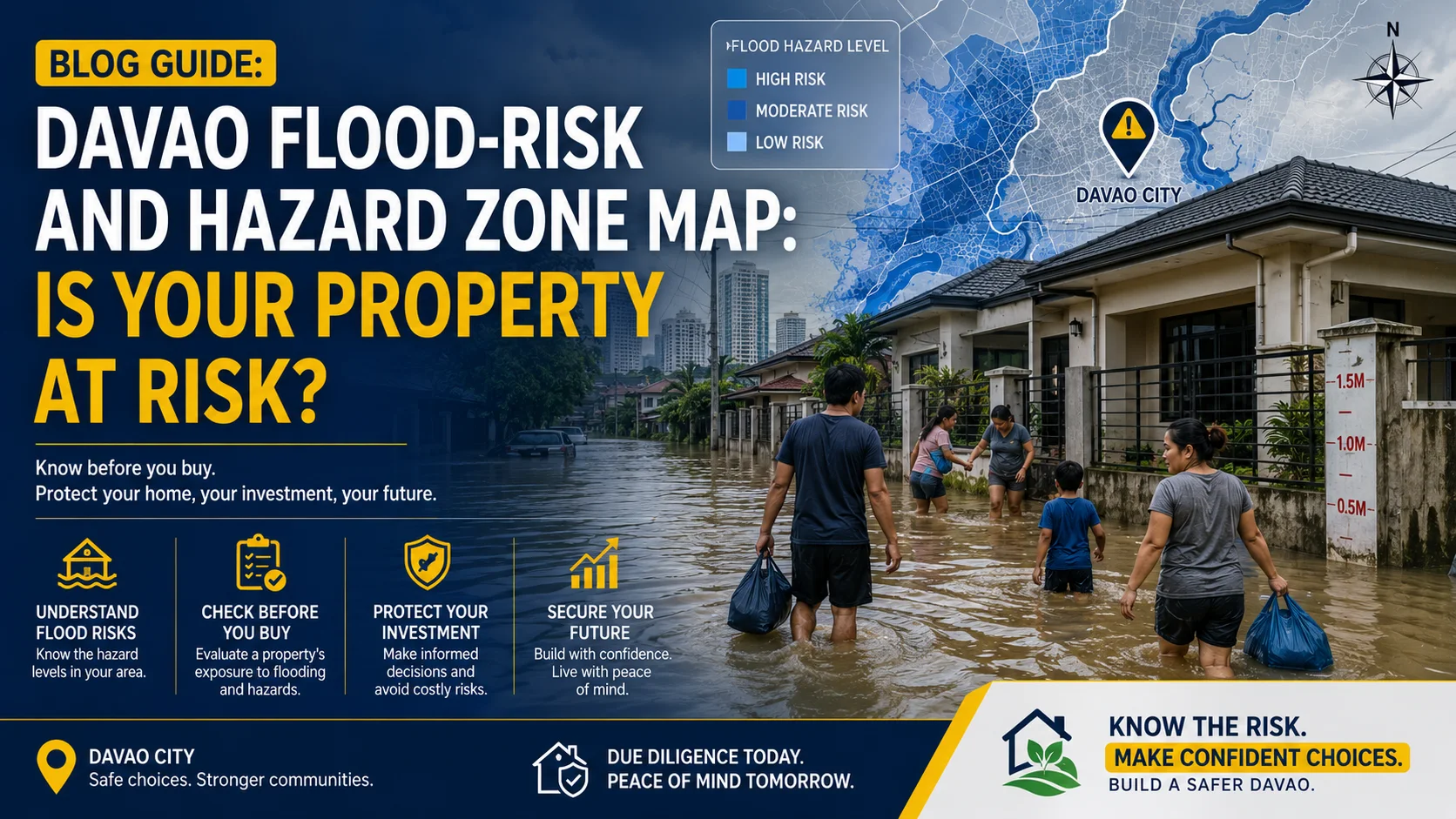
Davao Flood-Risk and Hazard Zone Map: Is Your Property at Risk? (2026)
Davao City has 265 identified flood-prone sites across three river corridors. Before you shortlist a property, here's how to check flood risk using free government tools and what the historical record actually shows.
This guide is for educational purposes only and does not constitute legal, financial, or investment advice. Philippine laws, BIR tax rates, DHSUD regulations, and Pag-IBIG policies change. Always verify current figures with the relevant government agencies and consult licensed professionals for advice specific to your situation. © 2026 MM Properties Davao. Last reviewed: June 2026.