
Davao market updates
Step-by-Step Guide: How to Verify a Land Title in the Philippines (2026)

Table of Contents
Never rely on a photocopy. Here's the exact step-by-step process for verifying a Transfer Certificate of Title or Condominium Certificate of Title in the Philippines and what red flags to watch for.
This guide is educational and maintained for Davao property buyers, sellers, and investors. For decisions specific to your situation, consult a licensed attorney, accountant, broker, or financing professional.
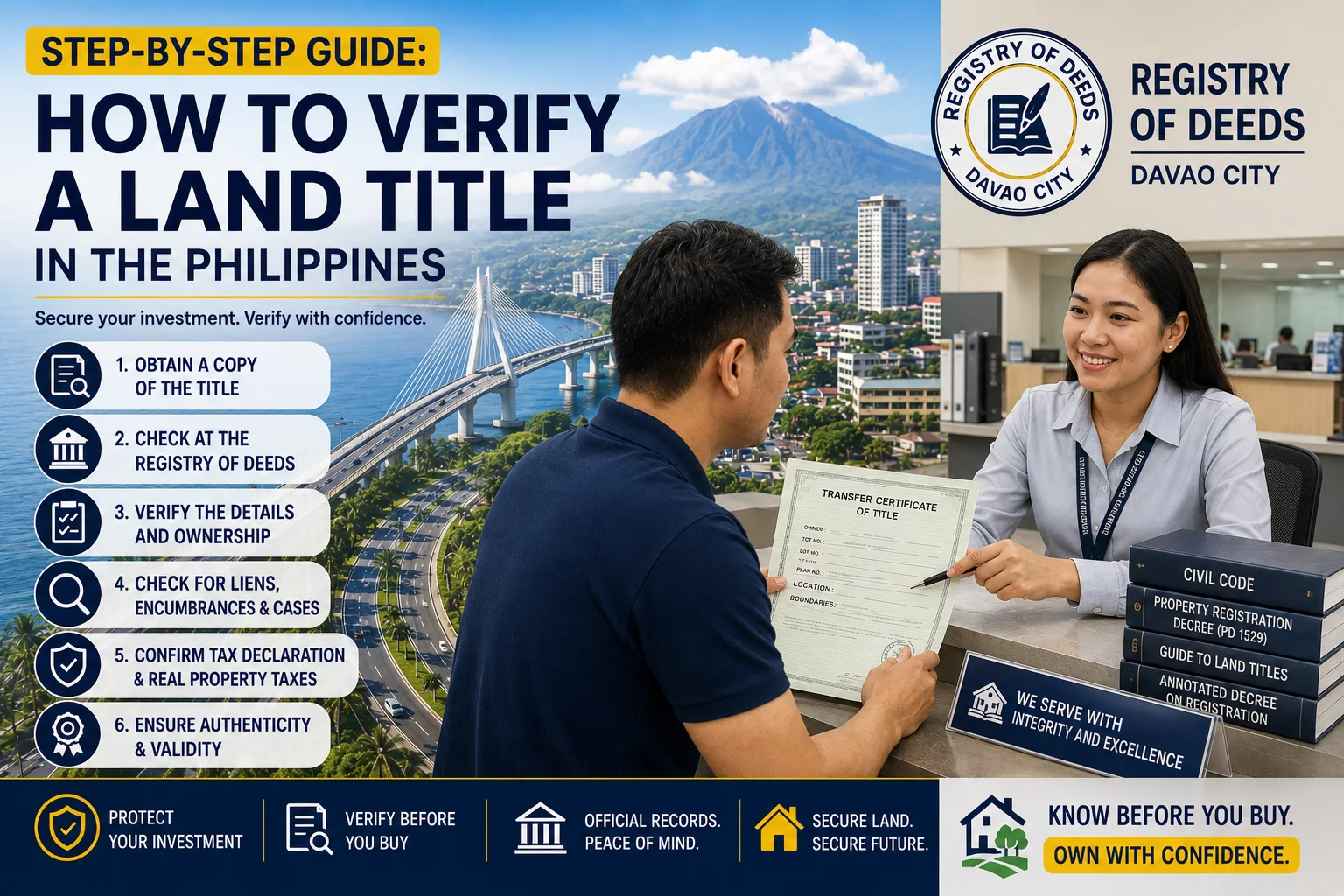
The Step Most Buyers Skip, until It's Too Late!
Every property in the Philippines comes with a story attached to its title. Most of the time, that story is clean: one owner, no disputes, no outstanding loans, no legal complications. The title is exactly what it appears to be. But not always. And the only way to know which situation you're in before you pay a reservation fee, before you sign a Contract to Sell, before any money changes hands, is to verify the title yourself at the Register of Deeds. Not read a photocopy. Not take the seller's word for it. Verify it. This guide shows you exactly how.
A Story Worth Reading First
Jerome had been searching for a house and lot in Davao for seven months when he finally found the right one, a resale property in a well-established subdivision in Catalunan Grande. The seller was friendly. The price was fair. The photocopy of the title looked legitimate. His agent told him to pay the reservation fee first, then verify the title. He almost did exactly that. Instead, on the advice of a colleague who had bought property before, he visited the Register of Deeds first. He requested a Certified True Copy of the title and spent twenty minutes reading it carefully with the help of a broker. There it was, on the back of the title, in the section he'd never thought to look: a mortgage annotation. The property had been used as collateral for a loan. The loan had not been fully settled. The seller had not disclosed it. Jerome walked away. His reservation fee, which he had not yet paid, stayed in his pocket. The seller's photocopy hadn't shown the encumbrance. The Certified True Copy did.
TCT vs. CCT: Which One Applies to You?
Before verifying a title, know which type you're looking at. Transfer Certificate of Title (TCT): Issued for land and house-and-lot properties. The TCT is the primary document of ownership for residential lots, house and lot units, and townhouses. Condominium Certificate of Title (CCT): Issued specifically for condominium units. The CCT confirms ownership of the unit itself and not the land beneath the building, which is owned collectively. The verification process is identical for both. The Register of Deeds holds records for both types and can issue a Certified True Copy of either upon request.
The Three Biggest Title Mistakes Buyers Make
Mistake 1: Accepting a Photocopy as Proof This is the most common and most dangerous shortcut in Philippine property transactions. A photocopy of a title can be:
- Altered or falsified without obvious signs of tampering
- Missing annotations on the reverse side that reveal encumbrances or legal claims
- A copy of a cancelled or superseded title no longer on record
The only document that proves a title is legitimate and currently recorded is a Certified True Copy (CTC) obtained directly from the Register of Deeds or through the LRA eSerbisyo online portal. Nothing else is sufficient.
Mistake 2: Not Reading the Memorandum of Encumbrances Check the the back of the title, or subsequent pages. They contain the Memorandum of Encumbrances. This is arguably the most important section to review. Encumbrances are legal claims or restrictions attached to the property. Common annotations include:
| Annotation | What It Means |
|---|---|
| Mortgage | Property is used as loan collateral; loan may not be settled |
| Lien or levy | A government or court claim against the property, often for unpaid taxes |
| Notice of Lis Pendens | Property is subject to active litigation! Ownership is disputed in court |
| Adverse Claim | A third party has formally asserted a right or interest over the property |
| Section 4, Rule 74 | Common on inherited property; title subject to other heirs' rights for two years |
A clean title has no annotations or has annotations that are clearly marked as cancelled or released. Any active annotation requires explanation and resolution before you proceed.
Mistake 3: Not Checking for Fake or Spurious Titles Fake titles often contain forged or incorrect serial numbers. If a title exists in a seller's hands but has no corresponding record at the Register of Deeds, it is fraudulent. If the seller presents a duplicate that looks authentic but the RD has no record of it, or if the RD's version has encumbrances not shown on the duplicate, these are serious red flags. Additional warning signs:
- The name on the title does not exactly match the seller's government-issued ID
- The title number format does not match the series used by the issuing Register of Deeds
- The seller is reluctant or evasive when asked for the title number prior to your visit
- The property's technical description does not match the actual lot boundaries
Step-by-Step: How to Verify a Title at the Register of Deeds
Option A: In Person (Recommended for Buyers) What you need before going:
- The title number (TCT or CCT number: ask the seller for this before anything else)
- The registered owner's name as it appears on the title
- A valid government-issued ID
- Cash for processing fees (minimum ₱300 for verification; CTC fees start at approximately ₱645 for a two-page document, You can verify current fees at the ROD)
- Step 1: Go to the correct Register of Deeds
- Visit the Registry of Deeds office that originally issued the title. In Davao, this is the Registry of Deeds for Davao City. Thanks to the LRA's Anywhere-to-Anywhere (A2A) system, you can also visit the nearest computerized ROD and obtain the necessary documents, eliminating the need for long-distance travel.
- Step 2: Request a Certified True Copy
- Fill out the request form available at the ROD. Submit the necessary details, such as the name of the owner and the title number. Pay the processing fee at the cashier and receive your Claim Assessment Slip.
- Step 3: Claim your CTC
- For local ROD transactions, requestors can claim their eTitle (PHILARIS Title) after one working day. Manual titles (converted titles) can be claimed after three working days from the date of request.
- Step 4: Read the CTC carefully
- Check the following, in order:
- Owner's name : matches the seller's ID exactly, character for character
- Title number : matches what the seller provided
- Property description: lot area, boundaries, and technical description match the property you visited
- Front of title: no visible alterations, corrections, or irregularities
- Memorandum of Encumbrances (back of title): read every annotation; confirm any present are cancelled or released
- No lis pendens, adverse claims, or active mortgages
Step 5: Cross-check with the Tax Declaration Request a Certified True Copy of the Tax Declaration. Verify that the registered owner's name and property details match the land title. Check if real property taxes have been paid. Unpaid taxes can prevent title transfer. Do this at the Davao City Assessor's Office, separate from the Register of Deeds visit.
Option B: Online via LRA eSerbisyo The Land Registration Authority's eSerbisyo portal (eserbisyo.lra.gov.ph) offers a convenient way to obtain a certified true copy of a land title online. Simply create an account and input the Registry of Deeds location, title type (OCT, TCT, or CCT), and the specific title number. Fees begin at ₱645 for a two-page document. The document is then delivered to your preferred address. This option is particularly useful for OFW buyers whose representatives are managing the verification process, or for buyers doing preliminary checks before an in-person visit.
Note: Online verification through eSerbisyo confirms that a record exists in the LRA database. For a complete review of encumbrances and annotations, an in-person visit to the Register of Deeds or a request for the full CTC, remains the most thorough approach.
Optional Step: LRA Central Office Verification For an added layer of security, you can request a Verification Certification from the LRA Central Office. This confirms that the specific title exists in their national database and matches the records submitted by the local ROD. This step is most relevant for high-value transactions or when something about the title has raised a question during your Register of Deeds visit. It is not typically necessary for straightforward purchases, but it is available.
For Pre-Selling Condominium Projects If you are buying a pre-selling condo unit, where the CCT does not yet exist because the building is not yet complete, verify instead:
- The master title of the land on which the building will stand (at the Register of Deeds)
- The developer's License to Sell at dhsud.gov.ph
- The development permit issued by the local government
- The developer's track record with past completed projects
The CCT for your specific unit is issued only after the building is completed and the condominium project is formally registered. Before that point, your protection rests on the developer's credentials and the Contract to Sell, not the title.
Quick-Reference: Title Verification Checklist
Print this or share it with your representative before any property visit. At the Register of Deeds:
- Request Certified True Copy and never rely on a photocopy
- Confirm title number matches seller's document exactly
- Confirm owner's name matches seller's government ID exactly
- Read the Memorandum of Encumbrances in full
- Confirm no active mortgage, lien, lis pendens, or adverse claim
- Confirm title is not cancelled or superseded
At the Davao City Assessor's Office:
- Request Tax Declaration and confirm it matches the title
- Confirm real property taxes are current and should have no arrears
- Confirm owner's name on Tax Declaration matches the title
Additional checks:
- For inherited property: confirm estate has been properly settled and title transferred to the seller's name
- For corporate sellers: verify SEC registration and board authority to sell
- For pre-selling condos: verify developer's DHSUD License to Sell at dhsud.gov.ph
What to Do If You Find a Problem
Active mortgage or lien: Ask the seller to show proof of loan settlement before proceeding. Do not proceed until the encumbrance is formally released and annotated as cancelled on the title. Name mismatch: Stop. Do not pay anything until the discrepancy is fully explained and supported by documentation. Consult a licensed attorney. No record at the Register of Deeds: The title may be fraudulent. Disengage immediately and consult a lawyer before taking any further steps. Unpaid real property taxes: The seller must settle all arrears before transfer can proceed. Confirm settlement with official receipts before signing anything.
The Bottom Line
Title verification takes one to three days and costs a few hundred pesos. A failed property transaction or worse, a completed purchase on a fraudulent or encumbered title, costs years and far more than money. Do this step first. Before the reservation fee. Before the Contract to Sell. Before any signed document or paid amount. Everything else in the buying process is built on the assumption that the title is clean. Verification is how you confirm that assumption is actually true.
Related reading
buying_guide
OFW Property Buying Guide: How to Purchase Property in Davao from Abroad (2026)
Thinking about buying property in Davao while working abroad? This definitive OFW guide covers the Special Power of Attorney, remote due diligence, Pag-IBIG eligibility, and how to do it safely.
buying_guide
The Complete Guide to Buying Property in Davao, Philippines (2026)
Planning to buy property in Davao? This guide covers everything from financial readiness to title transfer—written for first-time buyers, OFWs, and investors who want to make confident decisions.
buyer_update
Davao Flood-Risk and Hazard Zone Map: Is Your Property at Risk? (2026)
Davao City has 265 identified flood-prone sites across three river corridors. Before you shortlist a property, here's how to check flood risk using free government tools and what the historical record actually shows.
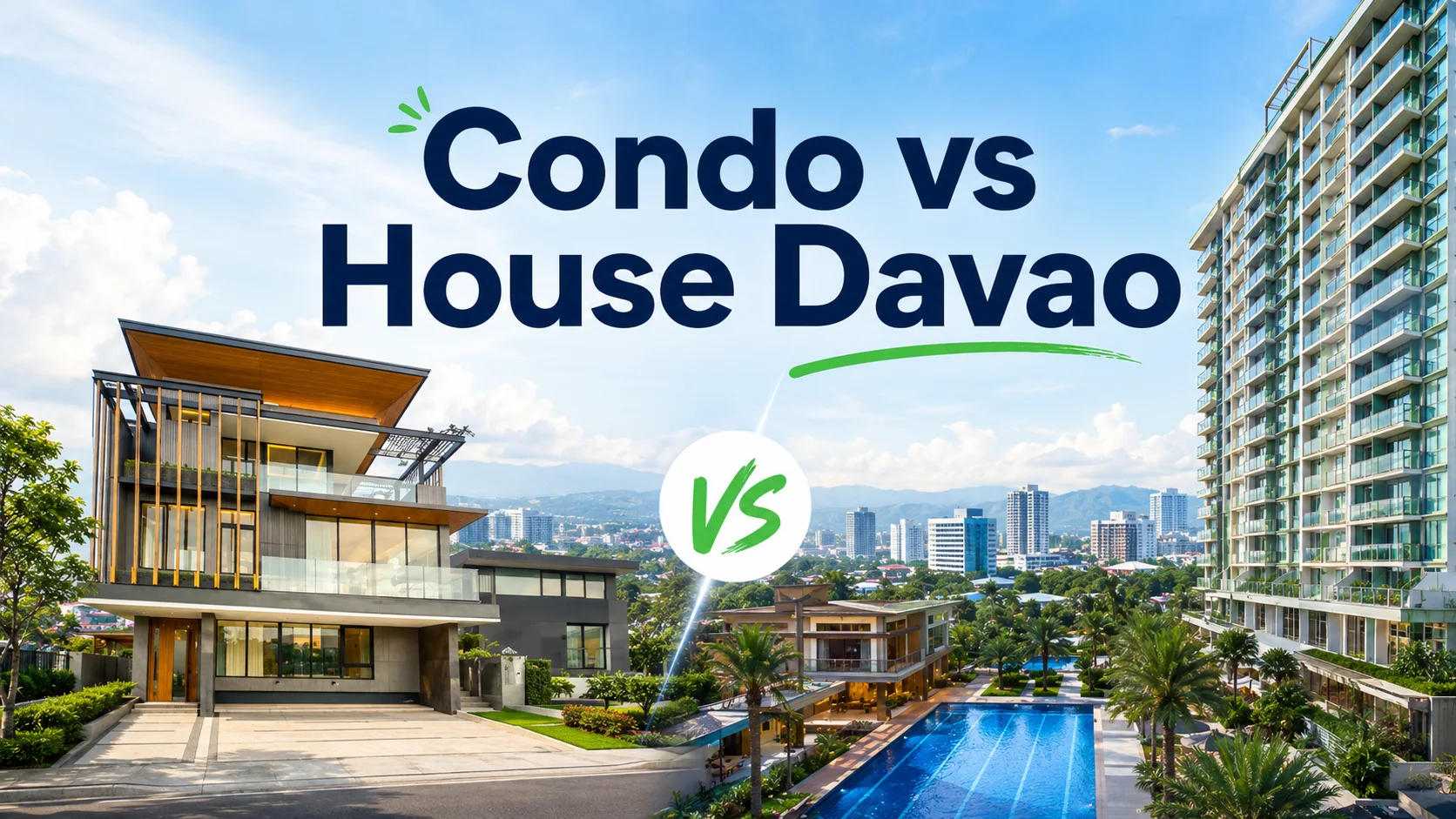
buying_guide
Condo vs. House and Lot in Davao: Which Is Right for You?
Torn between a condo and a house and lot in Davao? This honest comparison covers total cost of ownership, lifestyle fit, and long-term value , with a clear decision framework at the end.