
Buyer guides
OFW Property Buying Guide: How to Purchase Property in Davao from Abroad (2026)

Table of Contents
Thinking about buying property in Davao while working abroad? This definitive OFW guide covers the Special Power of Attorney, remote due diligence, Pag-IBIG eligibility, and how to do it safely.
This guide is educational and maintained for Davao property buyers, sellers, and investors. For decisions specific to your situation, consult a licensed attorney, accountant, broker, or financing professional.
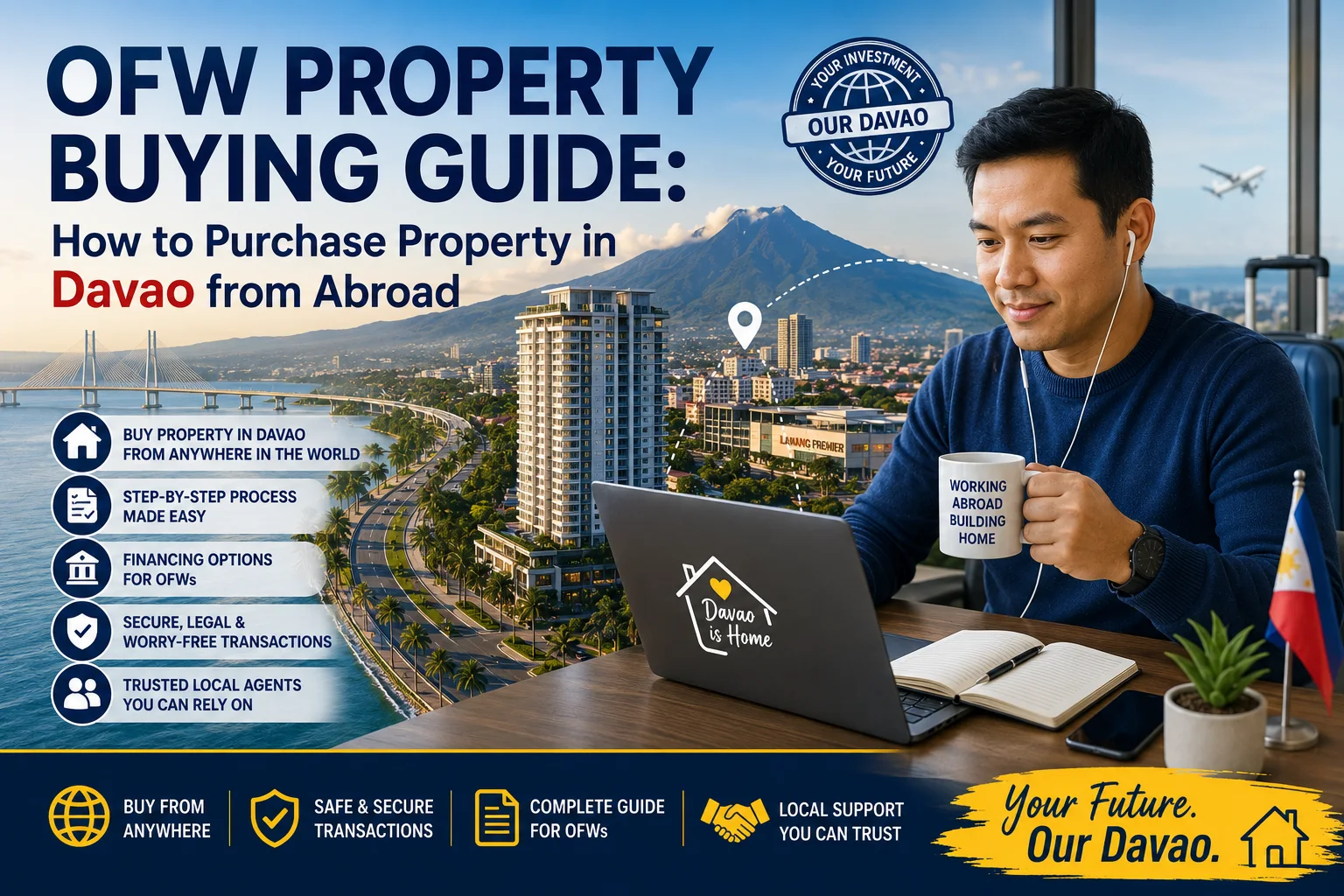
You've Been Thinking About This for a While
You're working thousands of kilometers from home. You're sending money back every month. And somewhere between the remittances and the long-distance calls, a question keeps surfacing: Shouldn't some of this be going into something permanent? For many OFWs from Davao and across Mindanao, property is that something. A house for the family. A condo generating rental income while you're still abroad. A lot in a growing area, bought now, built on later. The reasons are as varied as the people asking the question. What holds most OFW buyers back isn't the money. It's the distance. The fear of signing something you can't see. Of trusting someone with a decision this size when you can't be there in person. Of getting it wrong when you're too far away to fix it quickly. This guide exists to make the process clear, the risks visible, and the path forward manageable! Specially if you're from abroad.
Two Stories Before the Process
The cautionary one | Rolando, seaman, working in international waters Rolando had been at sea for four years when he decided to buy a house and lot in Toril for his wife and three children. He didn't have time to manage the process himself, so he signed a Special Power of Attorney giving his brother-in-law full authority to act on his behalf. The brother-in-law was not malicious. He was simply overwhelmed, undertrained, and too proud to say so. He signed a Contract to Sell without reading the deed of restrictions. He paid the reservation fee for a property the family had only seen once, in daylight, on a Sunday. He missed a documentary deadline that cost them their reservation fee. Eighteen months later, Rolando came home to a situation that required a lawyer to untangle. The property was eventually purchased — a different one — but the process cost more money, more time, and more family tension than it ever needed to. The problem wasn't the SPA. It was an SPA that was too broad, given to someone who wasn't prepared to use it.
The one that went right | Grace, nurse, working in the UK Grace had been planning her Davao property purchase for two years before she acted. She researched online for months. She joined OFW property buyer groups on Facebook. She asked her sister — a licensed accountant — to be her representative, not a relative who simply volunteered. Before signing the SPA, Grace and her sister video-called a licensed broker who walked them through every step, every document, and every risk. Grace limited the SPA to one specific property transaction with a defined price ceiling. Her sister visited the property three times, at different times of day, and sent videos each visit. Grace never saw the property in person before the title was in her name. She closed the transaction in under five months and moved her family in six weeks after returning home. The difference between Rolando and Grace wasn't luck. It was preparation, the right representative, and a clearly limited SPA.
art 1: The Special Power of Attorney : Your Most Important Document
The Special Power of Attorney (SPA) is the legal instrument that allows someone in the Philippines to act on your behalf in a property transaction. For OFWs, it is almost always necessary. It is also the single greatest source of risk if handled carelessly. What the SPA Should Specify A well-drafted SPA for property purchase should include:
- The full name and relationship of your authorised representative
- The specific property being transacted — address, title number, and price range
- The specific acts authorised — signing the Contract to Sell, paying the reservation fee, submitting documentary requirements, signing the Deed of Absolute Sale
- A price ceiling — the maximum amount your representative is authorised to commit to
- An expiry date — SPAs with no end date are unnecessarily open-ended
- Acts explicitly excluded — anything you do not want done without your direct involvement
Avoid general SPAs that grant broad authority over all your properties and financial affairs. The SPA should be a surgical instrument, not a blank cheque. How to Execute the SPA Abroad If you are abroad, your SPA must be:
- Notarised by a Philippine Consulate or Embassy in your country of posting — or by a local notary public in some jurisdictions, subject to apostille authentication
- Authenticated: Consular notariZation is generally sufficient for Philippine legal purposes; verify current requirements with the Philippine Embassy in your country
- Transmitted to your representative: original or authenticated copy, depending on what the transaction requires
Processing times at Philippine Consulates vary significantly by country. Schedule your SPA appointment well in advance of your intended transaction timeline. Choosing the Right Representative Your representative should be:
- Someone with the time and capacity to handle the process properly and not just someone you trust emotionally
- Willing to be briefed thoroughly and to ask questions when something is unclear
- Accountable! Ideally someone with something to lose professionally or personally if they handle it carelessly
- Not also a party to the transaction: Avoid representatives who have their own interest in the outcome
Licensed real estate brokers can serve as transaction managers who work alongside your representative, reducing the burden on a family member who may not be familiar with property documentation.
Part 2: Pag-IBIG OFW Eligibility: What Most OFWs Don't Know
Many OFWs assume Pag-IBIG housing loans are only for locally employed workers. They are not. OFWs, both land-based and sea-based, are eligible for Pag-IBIG housing loans provided they meet the contribution requirements. The program has a dedicated OFW membership track, and contributions made while working abroad count toward the 24-month minimum required for housing loan eligibility. How OFW Pag-IBIG Membership Works OFWs can contribute to Pag-IBIG through:
- Automatic enrollment: All OFWs are compulsory Pag-IBIG members under Philippine law
- Voluntary contributions: OFWs can make additional contributions to increase their loan entitlement
- Collection partners abroad: Pag-IBIG has accredited collection partners in many OFW-heavy countries; check the current list at hdmf.gov.ph
- Applying for a Pag-IBIG Housing Loan as an OFW
- The process mirrors the standard Pag-IBIG housing loan, with two key differences:
- 1. Your SPA covers the loan application
- Your authorized representative handles the physical application submission, attends loan counselling, and manages document submission on your behalf. Your SPA should explicitly authorize these acts.
- 2. Income documentation differs
- OFW income documentation typically includes your employment contract, proof of remittance, POEA documentation, and equivalent income proof from your employer abroad. Requirements vary so please verify the current OFW-specific checklist directly with HDMF before your representative submits anything.
Part 3: Due Diligence from Abroad: How to Verify What You Can't See
Buying a property you haven't physically visited is one of the most anxiety-inducing aspects of being an OFW buyer. It doesn't have to be. Done properly, remote due diligence is thorough enough to protect you from the most common risks. Here's how. What Your Representative Must Do in Person These cannot be delegated to video calls or photos:
- Visit the property at least twice: Do it on different days, different times of day, including a weekday morning for traffic and noise assessment
- Verify the title personally at the Register of Deeds: Bring a certified true copy request form, not just a photocopy provided by the seller
- Confirm tax payments are current at the Davao City Assessor's Office
- Walk the perimeter and assess flood risk, drainage, access roads, and neighbouring land use
- Talk to existing residents in the subdivision or building and not just the developer's sales staff
- For resale properties: arrange an independent structural inspection by a licensed engineer
What You Can Verify Remotely These you can and should do yourself from abroad:
- Developer DHSUD registration: Check the developer's License to Sell at dhsud.gov.ph. This is free, public and searchable.
- BIR zonal value: Verify the zonal value of the property at bir.gov.ph to understand the tax base
- Satellite and street view: Google Maps and Google Earth are imperfect but useful for assessing the area, proximity to roads, and surrounding land use
- Developer's reputation: Search the developer's name alongside terms like "complaint," "delay," or "HLURB" to surface any documented issues
- Community research: Facebook groups for Davao homebuyers, OFW communities, and subdivision residents often contain candid firsthand accounts that formal research won't surface
The Video Call Walkthrough Ask your representative to conduct a live video walkthrough of the property and not a pre-recorded video, which can be edited or selectively framed. Walk every room. Step outside. Pan to the street. Look at neighboring properties. Ask them to show you what the view is from the bedroom window, what the road looks like in both directions, where the nearest market and school are relative to the gate. It is not the same as being there but it is significantly better than not seeing it at all.
Part 4: Which Property Type Makes Sense for OFW Buyers?
OFWs buy for different reasons and the right property type depends entirely on which reason drives you.
| Your Primary Goal | Best Property Type | Key Consideration |
|---|---|---|
| Home for family while you're abroad | House and lot in an established subdivision | Prioritize subdivision security, HOA quality, and proximity to schools |
| Rental income while still overseas | Condo near Davao business districts | Model yield at 75–80% occupancy; research existing supply in the building's area |
| Long-term land investment | Residential lot in a growth corridor | Buy in areas with existing infrastructure, not just planned; 7–10 year horizon minimum |
| Retirement home for your return | House and lot or lot-only with eventual construction | Factor your target return date into the property's readiness timeline |
The Areas Most OFW Buyers Consider in Davao
- Catalunan Grande / Pequeño: Consistent demand from families, accessible price points, established subdivisions. A strong fit for the family-home buyer.
- Ecoland / Matina / Buhangin: Best rental demand for condo investors; higher entry price, tighter supply picture.
- Toril / Tugbok / Mintal: More space for the budget; longer commute. Best for families with flexible work arrangements or retirees.
- Samal Island: Lifestyle and retirement appeal; manage bridge-related appreciation as upside, not assumption.
Part 5: The OFW Buying Process: Start to Finish
Here is the complete sequence for an OFW purchasing property in Davao from abroad.
| Stage | Who Acts | What Happens |
|---|---|---|
| 1. Research and shortlisting | You (remotely) | Listings, area research, developer verification, DHSUD check |
| 2. SPA preparation | You + Philippine Embassy/Consulate | Draft, notarize, and authenticate SPA; transmit to representative. |
| 3. Property visits | Your representative | In-person visits, title verification, neighborhood assessment |
| 4. Video walkthrough | You + representative (live) | Remote viewing via video call |
| 5. Reservation | Your representative (via SPA) | Pay reservation fee; confirm refundability in writing first |
| 6. Financing application | Your representative + you (documents) | Pag-IBIG or bank application; OFW income documents from your end |
| 7. Contract to Sell review | You + representative | Review every page before signing; consult a lawyer if unclear |
| 8. Contract signing | Your representative (via SPA) | Signs on your behalf within authorized scope |
| 9. Loan processing | Your representative + HDMF/bank | Document submission, appraisal, evaluation |
| 10. Title transfer | Your representative (via SPA) | BIR payments, Register of Deeds, mortgage annotation |
| 11. Loan release | HDMF/bank → seller | Funds released; transaction completed |
| 12. Post-purchase | Your representative | Utility connections, HOA registration, key handover |
Typical total timeline: 4–9 months from reservation to title in your name. (For developer projects, you can ask a drafted SPA document from the developer but you still need to check/review it yourself)
What OFW Buyers Most Commonly Regret
Giving too broad an SPA. Every transaction detail your SPA doesn't specify is a decision someone else makes for you. The more specific your SPA, the more control you retain from abroad. Choosing a representative based on availability, not capability. The willing relative is not always the right choice. Capability, time, and accountability matter more than proximity. Buying based on a developer's video or brochure alone. Marketing materials are produced to sell. In-person visits by your representative and live video walkthroughs are non-negotiable. Not verifying Pag-IBIG eligibility before committing to other financing. Many OFWs discover their Pag-IBIG eligibility only after signing with a bank or accepting in-house financing. Check first. Rushing because you're home on a short vacation.The pressure of a limited window in the Philippines produces some of the worst property decisions OFW buyers make. A purchase this size deserves more than two weeks of in-person decision-making. If you can't complete the process properly during your leave, let your representative carry it through with a well-structured SPA.
Frequently asked questions
Do I need to be in the Philippines to buy property in Davao?+−
No. With a properly executed Special Power of Attorney, your authorized representative can manage the entire transaction on your behalf, from reservation through title transfer, while you remain abroad.
Can I use my OFW remittances as proof of income for a housing loan?+−
For Pag-IBIG housing loans, proof of remittance is accepted as part of OFW income documentation alongside your employment contract. For bank loans, requirements vary by lender. Verify the specific documentary requirements with your chosen financing institution before applying.
What if my family disagrees about which property to buy?+−
This is more common than most guides acknowledge. Establish your own written criteria, like location, size, budget, purpose, before involving family in the search. Your criteria, not family consensus, should drive the final decision. The property is yours!
How do I verify a developer from abroad?+−
Visit dhsud.gov.ph to check the developer's License to Sell. Search the developer's name in public Facebook groups and forums for firsthand buyer accounts. Ask your broker for references from buyers of the developer's completed projects.
Can my spouse act as my SPA representative?+−
Yes! For many OFW buyers, a spouse in the Philippines is the most practical representative. Ensure your spouse has the time, capacity, and willingness to manage the process properly. A motivated but overwhelmed representative creates its own risks.
The Bottom Line for OFW Buyers
Buying property in Davao from abroad is entirely achievable. Thousands of OFWs have done it well with the right representative, the right documents, and the right preparation. The distance doesn't have to be the obstacle. Unverified decisions, overbroad SPAs, and skipped due diligence are the actual risks. Name them, plan for them, and they become manageable. You've worked hard for the money going into this purchase. It deserves the same level of care you bring to everything else you do well.
Related reading

buying_guide
The Complete Guide to Buying Property in Davao, Philippines (2026)
Planning to buy property in Davao? This guide covers everything from financial readiness to title transfer—written for first-time buyers, OFWs, and investors who want to make confident decisions.
buying_guide
Complete Guide to Pag-IBIG Housing Loans for Davao Buyers (2026)
Pag-IBIG housing loans are more accessible than most Davao buyers realize and often cheaper than bank financing. Here's exactly how the process works, from eligibility to loan release.

buying_guide
Am I Ready to Buy Property in Davao? (Honest Quiz + Guide)
Hesitating on buying property in Davao? You're not alone. This short guide helps you figure out if the timing is right financially, emotionally, and practically before you take the next step.
This guide is for educational purposes only and does not constitute legal, financial, or investment advice. SPA requirements, Pag-IBIG eligibility, and Philippine property laws are subject to change. Consult a licensed Philippine attorney for advice specific to your transaction and jurisdiction. © 2026 MM Properties Davao. Last reviewed: June 2026.