
Buyer guides
Complete Guide to Pag-IBIG Housing Loans for Davao Buyers (2026)

Table of Contents
Pag-IBIG housing loans are more accessible than most Davao buyers realize and often cheaper than bank financing. Here's exactly how the process works, from eligibility to loan release.
This guide is educational and maintained for Davao property buyers, sellers, and investors. For decisions specific to your situation, consult a licensed attorney, accountant, broker, or financing professional.
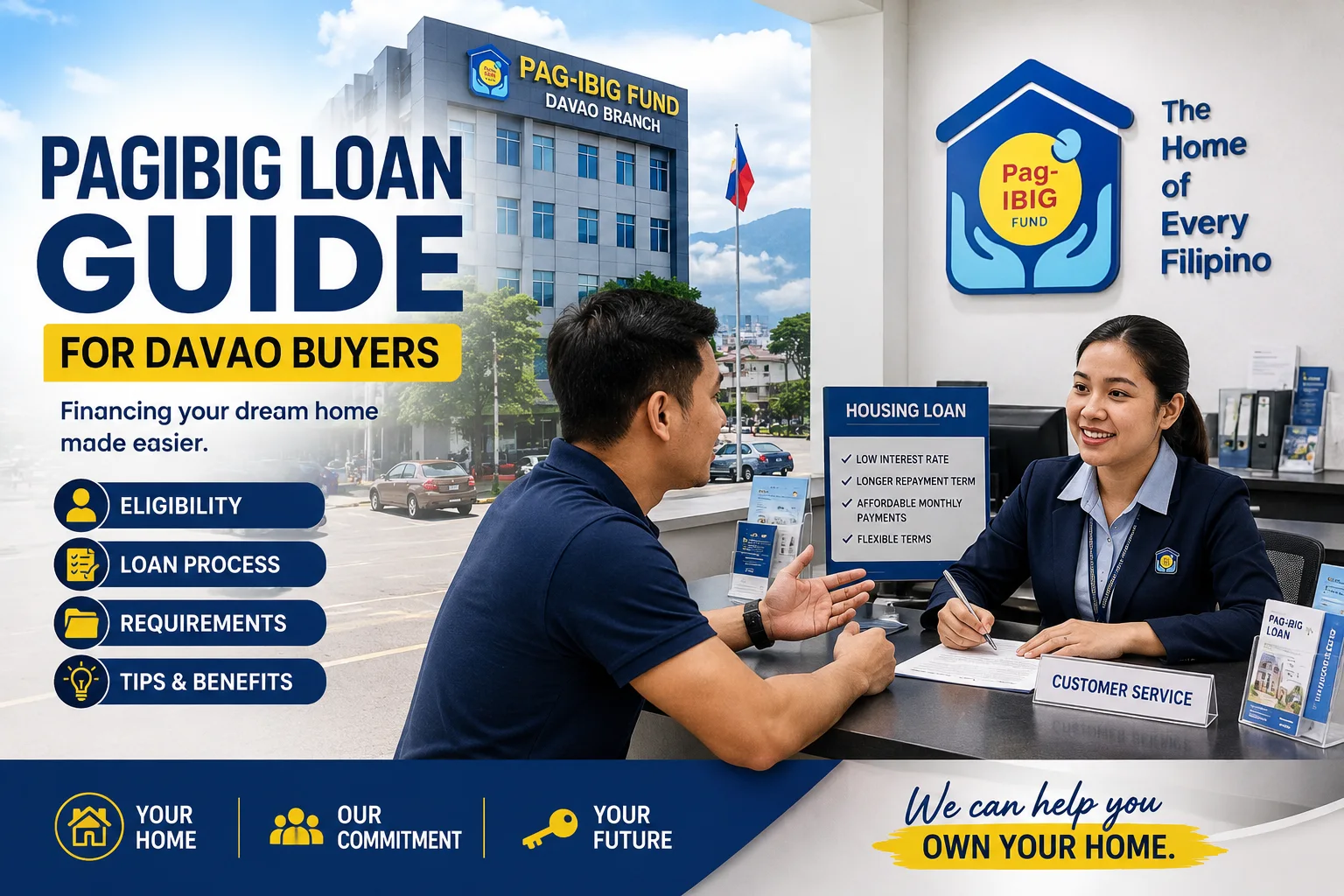
The Financing Option Most First-Time Buyers Overlook
When most Davao buyers start thinking about financing, they go straight to the bank. It feels familiar. Banks have branches everywhere, the process seems straightforward, and a friend probably used one recently. What many first-time buyers discover later — sometimes much later — is that they were eligible for a Pag-IBIG housing loan the entire time. And that the rate would have been lower. This guide exists so that doesn't happen to you. If you're a salaried employee, a self-employed worker, or an OFW with active Pag-IBIG contributions, you may qualify for one of the most accessible home financing options in the Philippines. The process is slower than a bank loan and requires patience. But for many buyers in the ₱5M–₱15M range, the long-term savings on interest are worth every extra week of paperwork. Here's exactly how it works.
A Story Worth Knowing First
Dante had been saving for a house and lot in Catalunan Grande for three years. When he was finally ready, his company's partner bank pre-approved him quickly — two weeks, clean process, competitive enough rate. He signed and moved forward. Six months after loan release, a colleague mentioned she'd used Pag-IBIG for a similar property at a noticeably lower interest rate. Dante did the math on what the difference would have meant over his 20-year term. It was a significant amount — not catastrophic, but real money he hadn't needed to spend. He hadn't even checked his Pag-IBIG eligibility. He hadn't known it was worth checking.
What Is the Pag-IBIG Housing Loan?
The Pag-IBIG Fund — formally the Home Development Mutual Fund (HDMF) — is a government agency that provides housing loans to Filipino workers and OFWs at subsidised interest rates. Because it is government-backed rather than profit-driven, its rates are structured to be accessible rather than competitive in the commercial sense. The Pag-IBIG housing loan can be used for:
- Purchasing a house and lot, townhouse, or condominium
- Purchasing a vacant residential lot
- Construction of a residential unit on owned land
- Home improvement or renovation (separate program)
For Davao buyers purchasing in the ₱5M–₱15M mid-range segment, the housing loan program is the most directly relevant.
Always verify the current maximum loanable amount and interest rate tiers at hdmf.gov.ph. These figures are updated by HDMF and change periodically.
Are You Eligible?
Pag-IBIG housing loan eligibility is broader than most buyers expect. You qualify if you meet all of the following:
- Active Pag-IBIG member with at least 24 monthly contributions (these do not need to be consecutive)
- Not more than 65 years old at the time of loan application, and not more than 70 years old at loan maturity
- No outstanding Pag-IBIG housing loan. Existing loans must be fully paid
- No Pag-IBIG housing loan that was cancelled or foreclosed in the past
- Legal capacity to acquire and encumber real property under Philippine law
OFWs with active Pag-IBIG contributions, including those enrolled under the voluntary OFW membership program, are eligible and can apply through authorized representatives or directly at HDMF offices.
How Much Can You Borrow?
The maximum loanable amount under the Pag-IBIG housing loan program is set by HDMF and subject to change. As a general guide, it is based on the lower of:
- The maximum loanable amount set by HDMF (verify the current figure at hdmf.gov.ph)
- Your loan entitlement based on your monthly contribution and gross monthly income
- The appraised value of the property
For buyers purchasing in the ₱5M–₱15M range, the HDMF-set ceiling may not cover the full purchase price. In this case, the gap is typically covered by the buyer's down payment, with Pag-IBIG financing the balance up to the eligible amount.
What Documents Do You Need?
Prepare these before you begin the application. Incomplete submissions are the single most common cause of delays. For all applicants:
- Accomplished HDMF Housing Loan Application form (available at any Pag-IBIG branch or hdmf.gov.ph)
- Valid government-issued ID (at least two)
- Proof of income (see below)
- Tax Identification Number (TIN)
- Transfer Certificate of Title (TCT) or Condominium Certificate of Title (CCT) — certified true copy
- Current Tax Declaration for land and improvement
- Contract to Sell or Deed of Absolute Sale (depending on transaction stage)
- Location plan and vicinity map of the property
Proof of income — by employment type:
| Employment Type | Required Documents |
|---|---|
| Employed (local) | Certificate of Employment with compensation, latest payslips (1–3 months), ITR or BIR Form 2316 |
| Self-employed | DTI or SEC registration, audited financial statements (2 years), ITR with BIR stamp, business permit |
| OFW | Employment contract, proof of remittance, POEA documentation, ITR or equivalent income proof |
The Step-by-Step Process: Application to Loan Release
This is the part most guides skip over. Here is exactly what happens, in order. Step 1: Attend loan counselling first Before anything else, attend the mandatory HDMF Loan Counselling Session at the nearest Pag-IBIG branch. This is not a formality at the end of the process — it happens at the beginning. You'll complete a Preliminary Counselling Questionnaire and a Membership Status Verification Slip, which staff use to confirm your eligibility before you fill out the formal application. Step 2: Verify your contributions At the same visit — or via your Virtual Pag-IBIG account at pagibigfundservices.com — confirm your total monthly contributions, check for any gaps, and verify your outstanding balance. Discrepancies in contribution records surface here. Resolve them before submitting anything. Step 3: Submit your loan application Submit your complete documentary requirements at the nearest Pag-IBIG branch servicing your area. In Davao, this is the HDMF Davao City branch. Incomplete submissions are returned and restart the clock — double-check every item on the checklist before you go. Step 4: Property appraisal HDMF appraises the property independently. The loan amount is based on the lower of the contract price or the appraised value. For resale properties, the appraised value sometimes comes in lower than the agreed purchase price — factor this into your budget before you're surprised by it at this stage. Step 5: Loan evaluation HDMF verifies your income, reviews your documents, and assesses your credit. This stage typically takes 4–8 weeks, sometimes longer depending on volume and document completeness. This is the honest reality of Pag-IBIG processing — it is slower than a commercial bank. Budget your timeline accordingly. Step 6: Notice of Approval (NOA) Once approved, HDMF issues the Notice of Approval. You review, confirm the terms, and sign. All subsequent steps must be completed within 90 days of NOA issuance, though an extension can be requested if needed. Step 7: Pay taxes at the BIR Before any money moves, you pay the required taxes — Capital Gains Tax and Documentary Stamp Tax — at the Bureau of Internal Revenue. This must be completed before title transfer can proceed. Step 8: Title transfer and mortgage annotation After finalizing the title transfer, you return the signed documents to Pag-IBIG and coordinate the release of the loan proceeds. This is the step that surprises most first-time buyers: the title transfers to your name — with the Pag-IBIG mortgage annotated on it — before the funds are released. The Register of Deeds processes the new Transfer Certificate of Title here. Step 9: Submit post-transfer documents to Pag-IBIG Return the new TCT (with mortgage annotation), updated Tax Declaration, and all remaining signed documents to HDMF for final processing. Step 10: Loan release Funds are released to the seller, developer, or contractor depending on the loan type. For developer-purchased properties, the developer typically coordinates this directly with HDMF, which simplifies the process significantly for the buyer. Step 11: Amortization begins Your payment schedule is issued and your first monthly amortization is typically due the month following loan release.
The title transfers to your name before the seller receives a single peso, not after. Pag-IBIG requires the mortgage to be legally annotated on the title in their favor before releasing funds. Budget both time and closing costs for this stage. It sits between approval and payment, and it's where most delays happen. Buying from a developer? The sequence above applies primarily to resale properties. If you're purchasing from an accredited developer, the process is considerably simpler. The developer manages the documentation and title coordination directly with HDMF, reducing the number of steps you handle personally.
Frequently asked questions
Can I use Pag-IBIG to buy a condo in Davao?+−
Yes. Pag-IBIG housing loans cover condominium units, subject to HDMF's current maximum loanable amount and the building's accreditation status. Confirm with HDMF whether the specific project you're considering is accredited.
Can I apply for a Pag-IBIG housing loan if I'm self-employed?+−
Yes, with audited financial statements and ITR documentation. Self-employed applicants typically face closer income scrutiny than salaried applicants — ensure your financial records are current and properly prepared.
What happens if my Pag-IBIG loan is not enough to cover the full purchase price?+−
The gap between the Pag-IBIG loan amount and the purchase price is covered by your down payment, savings, or supplemental financing. Discuss the specific arrangement with your developer or seller early in the process.
Can I pay off my Pag-IBIG housing loan early?+−
Yes. Pag-IBIG allows pre-payment without penalty. Early payoff reduces your total interest cost . This is worth considering if your financial situation improves during the loan term.
The Bottom Line
Pag-IBIG is not the right financing choice for every buyer. If you need fast loan release, are purchasing above the maximum loanable amount, or have an irregular contribution history, bank financing may be the more practical path. But if you're a salaried employee or OFW with at least 24 contributions and a patient timeline, a Pag-IBIG housing loan deserves a serious look before you sign with a bank. The rate difference over a 20-year term is real money — and it belongs in your comparison, not your regrets.
- Ready to understand the full buying process? Read the Complete Guide!
- Not sure if you're financially ready yet? Take the buyer readiness quiz.
Related reading
market_update
Davao Real Estate Market Overview (2026): What Every Informed Buyer Needs to Know
Davao's property market has been quietly outpacing many Philippine cities. Here's an honest, area-by-area look at what's driving demand, which corridors are emerging, and what it means for buyers in 2026.
buying_guide
Condo vs. House and Lot in Davao: Which Is Right for You?
Torn between a condo and a house and lot in Davao? This honest comparison covers total cost of ownership, lifestyle fit, and long-term value , with a clear decision framework at the end.
buying_guide
Why Davao City Real Estate Is a Smart Investment for Investors, OFWs, and First-Time Home Buyers
The demand for Davao City real estate continues to grow as more investors, Overseas Filipino Workers (OFWs), and working professionals recognize the value of owning property in one
This guide is for educational purposes only. Pag-IBIG loan amounts, interest rates, and eligibility requirements are set by HDMF and subject to change. Always verify current figures directly at hdmf.gov.ph or at the nearest Pag-IBIG branch before making any financing decision. © 2026 MM Properties Davao. Last reviewed: January 2026.